Share of Voice Calculator
Most Share of Voice calculators give you one number from a formula you could compute by hand. nqzai tracks two kinds automatically — how much of the AI-answer conversation you own, and how much of your real traffic actually comes from each channel — both weighted, both trended over time.
- SOV % = your brand's mentions ÷ total mentions (brand + named competitors) × 100 — nqzai also computes a prominence-weighted version and a concentration score, not just the raw percentage.
- Two distinct capabilities, not one: AI-answer-engine SOV (ChatGPT, Claude, Gemini, Perplexity, Google AI Overviews) and traffic Share of Voice (from your own connected Search Console + Analytics data).
- A single-engine taste is free; a full multi-engine competitive run costs ~8.5M tokens worst-case; traffic Share of Voice costs nothing extra.
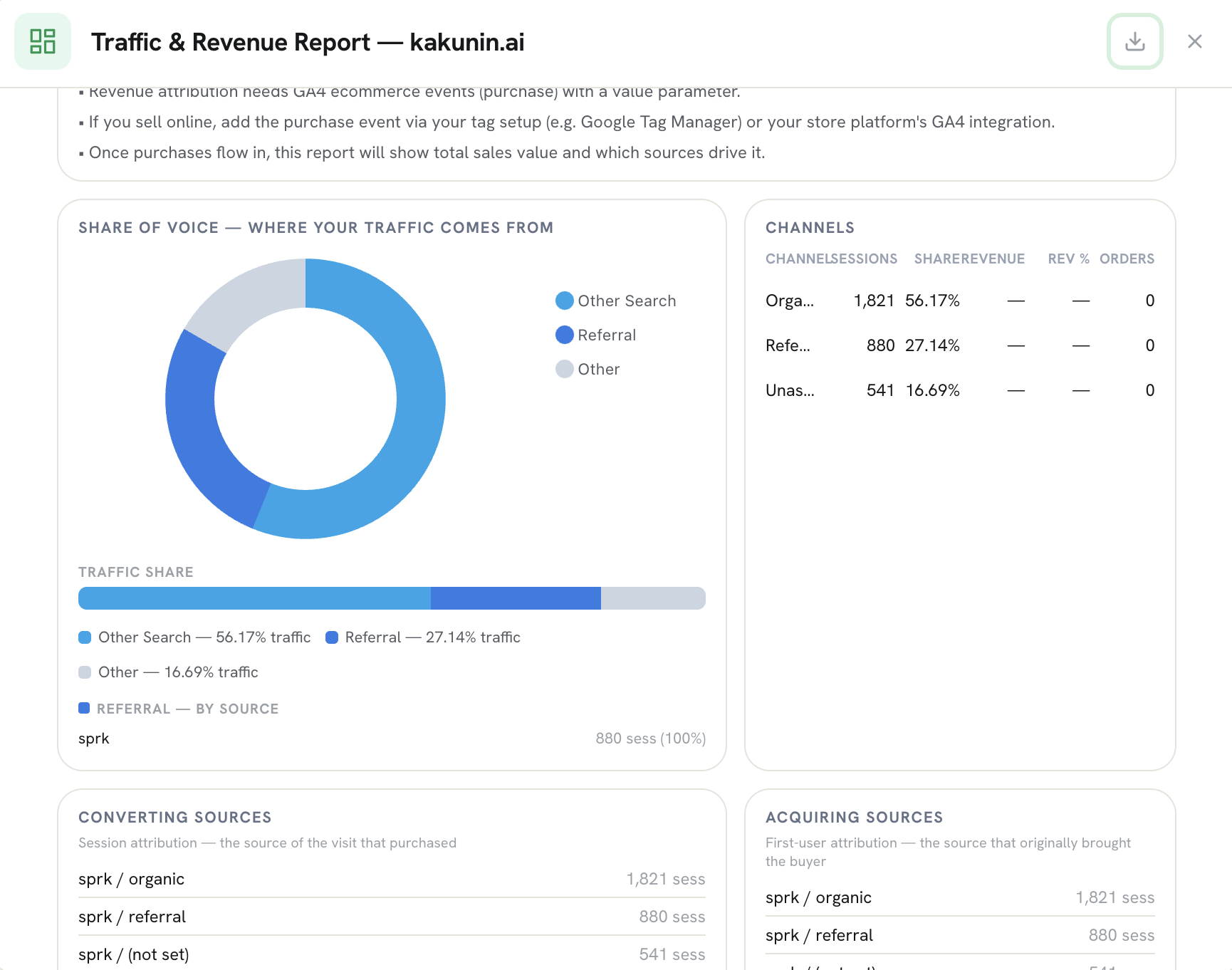
A real nqzai Share of Voice report — brand vs. competitor split, weighted by prominence.
What is Share of Voice (SoV)?
Share of Voice is the percentage of total attention in a category that belongs to your brand versus your named competitors, in whatever channel is being measured — historically media coverage or social conversation, and increasingly AI-generated answers as more discovery moves through ChatGPT, Perplexity, and Google AI Overviews instead of a traditional search results page.
It's a competitive, relative metric by construction: it only means something in the context of a named competitor set. "40% brand mentions" alone tells you little; "40% share against 4 named rivals" tells you exactly where you stand.
Share of voice formula: how to calculate it
The base calculation is straightforward:
Raw mention-counting has a real blind spot, though: it treats a brand a model actively recommends the same as one it mentions once in passing. nqzai's Share of Voice report computes a second number alongside the raw percentage — a weighted SOV that scores each mention by how prominently it appeared (recommended outranks listed, which outranks a plain mention, which outranks a citation with no text reference), plus a bonus for mentions that appear early in a response rather than buried at the end. All raw event counts are summed across every engine and prompt before dividing once — averaging a set of per-prompt percentages together skews small panels and was deliberately avoided.
A third number — concentration — comes from a Herfindahl-Hirschman Index (HHI) computed over the competitor set's shares, labeling the market winner-take-most, concentrated, or competitive. Two brands can post the same 35% SOV in categories that behave completely differently: one where a single competitor also holds 35% (competitive), and one where the remaining 65% is split thin across six also-rans (still effectively winner-take-most between two players).
How to measure share of voice: AI answers vs. search traffic
"Share of voice" gets used for two genuinely different things, and conflating them produces bad decisions. nqzai measures both, separately:
- AI-answer-engine SOV — how often AI systems mention your brand when answering a category question, versus named competitors, across ChatGPT, Claude, Gemini, and Perplexity, plus Google AI Overviews. This is simulated: real prompts are sent to real engines and the responses are parsed for brand and competitor mentions, citations, and prominence.
- Traffic Share of Voice — a completely different measurement: what fraction of your site's actual referral sessions and revenue come from each channel — organic search, direct, paid, social, and AI chat engine referrals specifically — pulled straight from your connected Google Search Console and Analytics data. This one isn't simulated at all; it's your real numbers, merged and attributed.
The two often move in opposite directions before converging — a brand can grow AI-answer SOV well before AI referral traffic shows up in Analytics, since being mentioned and being clicked-through are different events.
How to track share of voice over time
Once a competitive AI-answer check has run at least once, its trend view reads that saved history back at no extra token cost — no new engine calls, just reading stored results — and marks points where the competitor set itself changed, so a share jump from adding a weaker rival to the tracked set isn't mistaken for real growth. An automatic weekly re-run can be switched on for hands-off tracking; each weekly run is a real multi-engine check and bills tokens like any other.
What is a good share of voice percentage?
There's no fixed target — it's entirely a function of how many competitors are in the set and how the category concentrates. What matters more than the raw number is whether the result is statistically meaningful: nqzai's report explicitly flags results built on fewer than 2 tracked competitors or fewer than 5 total mention events as noisy, since a headline "80% SOV" computed from four total mentions in the sample is a small-sample artifact, not a stable signal worth acting on.
Share of voice vs market share
Market share is a lagging indicator, computed from actual sales: your revenue divided by total category revenue, typically reported quarterly. Share of voice is a leading indicator of attention: how much of the current conversation — media, social, or AI answers — belongs to you right now. SOV shifts are commonly treated as an early signal of where market share is headed, not a substitute for it; a brand's mention share can move weeks or months before its sales numbers reflect the same trend.
How to increase your share of voice
Two levers matter most, in order of leverage:
- Move existing mentions up the prominence hierarchy. A brand that's merely cited needs to become one an AI engine actively recommends — which comes from clearer entity signals (an unambiguous, consistent brand identity across the web an engine can resolve confidently) and content structured for direct extraction rather than just human skimming. A GEO-optimized content strategy and clean content quality signals both feed this directly.
- Increase the volume of citable, factual surface area. More clearly-structured, fact-dense content gives AI engines more material to draw on and quote correctly — a different job than classic link-building, closer to making sure the facts about your brand are unambiguous and easy for a model to extract without error.
How nqzai compares
| Tool | Engines / sources tracked | Starting price | Weighted by prominence? |
|---|---|---|---|
| Mention | Social, web & news mentions — not AI-answer engines | From ~$41/mo (Solo, billed annually) — verify current rate | No — raw mention/reach count |
| Siftly | ChatGPT + Google AI Mode (Perplexity/Gemini/Copilot on higher tiers) | From $79/mo (1 product tracked) | Slices by platform/topic/trend; not stated as prominence-weighted |
| Cognizo | 10+ engines (ChatGPT, Gemini, AI Overviews, Perplexity, Copilot, Meta AI, Claude, Grok, DeepSeek) | From $149/mo (annual) | Not stated as prominence-weighted |
| Profound | 1–10 engines depending on plan | From $99/mo | Not stated as prominence-weighted |
| AthenaHQ | 5–9+ engines | Free (Essential tier) / from $295/mo | Not stated |
| Semrush AI Visibility | 4–6 engines | From $99/mo per domain | Factors mention frequency + positioning (per Semrush) |
| Ahrefs Brand Radar | 6 engines | From $199/mo per platform | Not stated |
| nqzai | ChatGPT, Claude, Gemini, Perplexity + Google AI Overviews (5 surfaces) | Pay-as-you-go tokens, 1M free — free single-engine taste, ~8.5M tokens worst-case for a full competitive run | Yes — prominence-weighted + concentration (HHI) score, plus a separate free traffic Share of Voice |
Pricing current as of this page's publish date, sourced from each vendor's own pricing/feature pages and independent 2026 comparisons where a vendor's pricing page couldn't be reached directly. Pricing changes — verify current rates directly with each vendor before budgeting.
Reports tell you what happened. Ask nqzai why.
Share of voice is a number that moves. The useful question is never what it is — it is why it moved, and whether anything you did caused it. A dashboard cannot answer that; it can only show you the line.
The report is still produced and saved — it rides along as the evidence for the answer, instead of being handed over in place of one. You can open it, copy it, or push it to your CMS. You just don’t have to read it to find out what changed.
See your real Share of Voice, both kinds
One prompt runs the AI-answer competitive check; a separate free report shows your actual traffic Share of Voice from your connected Google data.
Frequently asked questions
What is share of voice in marketing?
Share of voice (SOV) is the percentage of total "mentions" in a category that belong to your brand, versus your named competitors — traditionally counted across media, social, or search, and increasingly across AI-generated answers as more people ask ChatGPT or Perplexity instead of searching directly. It's a relative metric, not an absolute one: a brand can grow its raw mention count and still lose share of voice if competitors grow faster.
What is the share of voice formula? How do you calculate it?
The base formula is: SOV % = (your brand's mentions ÷ total mentions across your brand and named competitors) × 100. If your brand gets 10 mentions out of 100 total category mentions, your SOV is 10%. nqzai computes this exact formula, plus a weighted version that counts a mention's prominence — being recommended outranks being merely listed, which outranks a passing mention, which outranks a citation with no text reference at all — so a brand that gets fewer but more prominent mentions can show a higher weighted SOV than raw mention-counting would suggest.
What's a good share of voice percentage?
There's no universal target — it depends entirely on how many competitors are in the set and how concentrated the category is. An even 3-way market has a natural ceiling around 33% per player; a 40% share means something different in a 3-brand set than in a 10-brand set. nqzai reports a concentration score (a 0-1 index over the competitor set's shares) alongside the raw percentage, labeled winner-take-most, concentrated, or competitive — and flags results built on fewer than 2 tracked competitors or fewer than 5 total mention events as statistically noisy, since an "80% SOV" from 4 mentions is a sample-size artifact, not a real signal.
Share of voice vs market share — what's the difference?
Market share is a lagging, revenue-based metric: your actual sales divided by total category sales, usually reported quarterly from real transaction data. Share of voice is a leading, attention-based metric: your visibility in the conversation right now, whether that's press mentions, social conversation, or AI-answer citations. SOV often moves before market share does — a rising SOV is treated as an early signal of future demand or awareness, not a substitute for revenue numbers.
How do I track share of voice over time?
Once a competitive check has run at least once, nqzai's trend view reads that saved history back — at no extra token cost, since it's just reading stored results, not firing new AI-engine calls — and shows how your share moved across runs, with markers where the competitor set itself changed (so a share jump caused by adding a weaker competitor isn't mistaken for organic growth). An automatic weekly re-run can be turned on, which does bill tokens each week it fires, since each run is a real multi-engine check.
How do I increase my share of voice?
Two levers, in order of leverage: first, existing mentions need to move up the prominence hierarchy — a brand that's merely cited needs to become one AI engines actively recommend, which comes from clearer entity signals (a well-defined Knowledge Graph presence, consistent brand facts across the web) and content structured for direct extraction, not just for human readers. Second, straightforwardly more of the underlying content and citable assets needs to exist for AI engines to draw on. This is a different job than classic SEO link-building — it's closer to making sure the facts about your brand are unambiguous and easy for a model to quote correctly.
Does nqzai measure AI share of voice, traditional share of voice, or both?
Both, and they're genuinely different metrics measuring different things — worth not conflating. AI-answer SOV measures what fraction of AI-generated responses (ChatGPT, Claude, Gemini, Perplexity, Google AI Overviews) mention your brand versus named competitors, weighted by how prominently. Traffic share of voice measures something else entirely: what fraction of your site's actual referral traffic and revenue comes from each channel — organic search, direct, paid, social, and AI chat engine referrals — pulled from your own connected Search Console and Analytics data, not simulated AI conversations.
Is there a free share of voice calculator?
The formula itself is public and free to apply by hand (mentions ÷ total mentions × 100) if you're counting manually. Automated tracking is the part every tool in this space charges for, nqzai included — running real prompts against multiple AI engines has a real cost. What nqzai gives for free: a genuine single-engine taste (ChatGPT only, a handful of prompts) with no top-up required, plus every new account's 1 million free signup tokens, plus the entire traffic share of voice side (inside the free GSC + GA4 report) at no extra token cost at all — it's the AI-answer multi-engine competitive tracking specifically that's metered.