Best AI Visibility Tools for AI Search Optimization
Generative Engine Optimization tools all answer one question — is my brand showing up in AI answers — but most stop at reporting the number. Here's how the category's best-known tools compare, and where detecting a problem and fixing it live in one place instead of two.
- GEO/AI-visibility tools run prompts against ChatGPT, Perplexity, Gemini, and Google AI Overviews on a schedule and report brand mention share versus named competitors.
- Several well-reviewed tools (Ahrefs Brand Radar, Otterly's base tier) are monitoring-only — no citation-source detection, no prioritized fixes.
- nqzai tracks 5 answer surfaces (fewer than Profound's 10) but bundles entity recognition, page-readiness, and citation-source detection into one composite score with prioritized actions, ~13M tokens worst-case for the full audit.
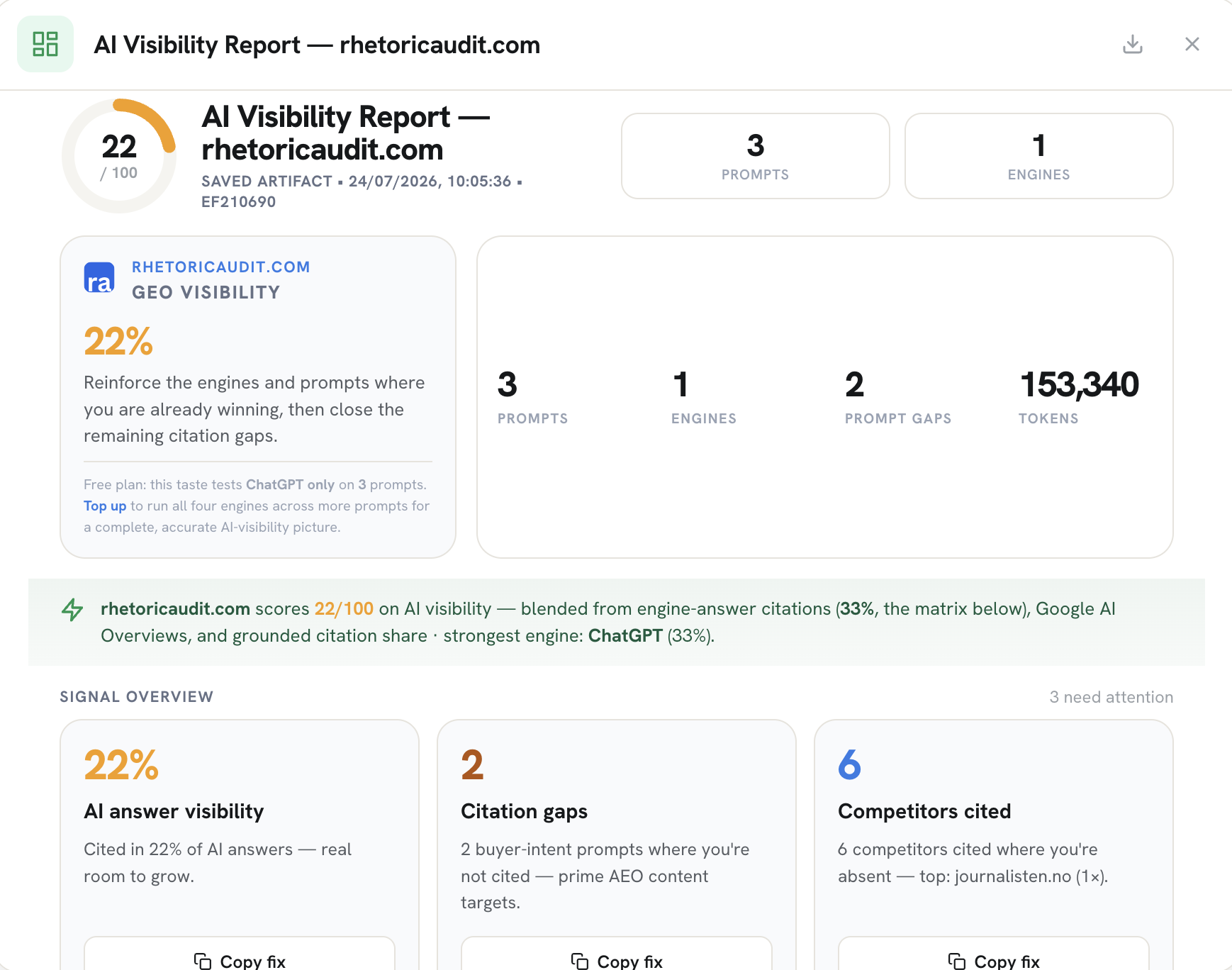
A real nqzai AI Visibility Score — entity, page-readiness, and citation checks in one composite.
What is AI search optimization (GEO)?
AI search optimization — usually called Generative Engine Optimization, or GEO — is the practice of making a brand and its content findable, citable, and recommendable by AI answer engines, the way SEO makes a page rankable on a results page. The tools in this category exist to answer a specific, recurring question: when someone asks ChatGPT, Perplexity, or Google's AI Overviews a category question, does this brand get mentioned, how often, and how does that compare to named competitors.
Track ChatGPT, Perplexity & Google AI Overviews brand mentions
Brand-mention tracking works by sending a set of realistic buyer-intent prompts to each AI engine and parsing the responses for brand and competitor mentions — this is the core loop every tool in this category runs, just with different engine coverage and prompt-set sizes. nqzai runs this across ChatGPT, Claude, Gemini, and Perplexity directly, plus Google AI Overviews as its own tracked surface, in every check — not gated behind a separate paid add-on the way Gemini is on Otterly's or Peec AI's base tiers.
AI citation tracking & citation source detection
Citation tracking is a narrower, more useful question than mention tracking: not just "did the engine mention this brand" but "which specific URL or domain did it actually cite as its source." This is a real gap in parts of the category — independent reviews note Ahrefs Brand Radar reports visibility numbers without identifying which pages engines cited. nqzai's research capability answers that directly for a given topic: which sources a specific AI engine is drawing its answer from right now, so content gaps can be targeted at the actual pages winning citations, not guessed at.
Share of voice in AI search
Once mentions and citations are being tracked, the natural next question is competitive: what percentage of the AI-answer conversation belongs to this brand versus named rivals, weighted by how prominently each mention appeared. That's a full topic on its own — see how nqzai calculates and tracks AI Share of Voice for the formula, the prominence-weighting methodology, and how it's trended over time.
Best AI visibility & GEO tools, compared (2026)
| Tool | Engines tracked | Starting price | Best for |
|---|---|---|---|
| Profound | Up to 10 (ChatGPT, Perplexity, Gemini, Copilot, Meta AI, Grok, DeepSeek, Claude, Google AI Overviews/Mode) | From $82.50/mo (annual, 50 prompts) | Enterprise-scale, most engines tracked |
| Otterly.AI | Google AI Overviews, ChatGPT, Perplexity, Copilot; Gemini/AI Mode as paid add-ons | From $25/mo (annual, 15 prompts) | Cheapest entry point |
| Peec AI | ChatGPT, Perplexity, Google AI Overviews baseline; Gemini/Claude/others for extra fee | From €89/mo (annual, 25 prompts) | Smart prompt suggestions, shareable reports |
| ZipTie | Google AI Overviews, ChatGPT, Perplexity only | From $58.65/mo (annual, 500 checks) | Content-optimization workflow, AI Success Score |
| Semrush AI Toolkit | ChatGPT, Google AI, Gemini, Perplexity | $99/mo per domain (Semrush add-on) | Existing Semrush users |
| Ahrefs Brand Radar | Google AI Overviews/Mode, ChatGPT, Perplexity, Gemini, Copilot | $199/mo add-on | Competitor benchmarking; no citation-source detection |
| Clearscope | ChatGPT, Gemini, Perplexity | From $129/mo (Essentials) | Content creators, AI-drafting workflow |
| nqzai | ChatGPT, Claude, Gemini, Perplexity + Google AI Overviews (5 surfaces) | Pay-as-you-go tokens, 1M free — free single-engine taste, ~13M tokens worst-case for the full composite audit | Detection + prioritized fixes + citation-source detection, in one agent — not monitoring alone |
Pricing current as of this page's publish date, sourced primarily from independent 2026 comparisons and each vendor's own pricing page. Pricing changes — verify current rates directly with each vendor before budgeting.
Reports tell you what happened. Ask nqzai why.
Most AI-visibility tools return a score and a citation count. A score tells you where you stand; it does not tell you why an answer engine picked someone else, which is the only thing you can act on. nqzai treats that as the actual question.
The report is still produced and saved — it rides along as the evidence for the answer, instead of being handed over in place of one. You can open it, copy it, or push it to your CMS. You just don’t have to read it to find out what changed.
Get the AI Visibility Score with fixes attached
One request runs entity recognition, page-readiness, and multi-engine citation checks in parallel and returns a composite 0-100 score with prioritized next actions — not just a dashboard number.
Frequently asked questions
What is generative engine optimization (GEO)? What are GEO tools?
Generative Engine Optimization is the practice of optimizing content and brand presence to be found, cited, and recommended by AI answer engines — ChatGPT, Perplexity, Google AI Overviews, Gemini — the way traditional SEO optimizes for ranking in a search results page. GEO tools are the monitoring layer underneath that practice: they run prompts against those engines on a schedule and report back whether, how often, and how prominently a brand gets mentioned versus named competitors.
What's the best AI visibility tool?
It depends on what's missing today. Profound tracks the most engines (up to 10) and is built for enterprise scale. Otterly.AI is the cheapest way to get a real taste. Peec AI and ZipTie lean into smart prompt suggestions and content-optimization workflows respectively. Several of the well-reviewed options — including Ahrefs Brand Radar and Otterly on its base tier — are explicitly monitoring-only: they report a number but don't tell you what to fix or track citation sources. nqzai's angle is different: detection and action live in one agent, so a low AI Visibility Score comes back with prioritized fixes, not just a dashboard.
What's the cheapest AI monitoring tool?
Otterly.AI's Lite plan, from $25/month billed annually for 15 prompts, is the cheapest named entry point among dedicated AI-visibility tools — though it covers a narrower prompt set and Gemini/Google AI Mode sit behind a paid add-on even on that plan. nqzai doesn't have a flat subscription at all: pay-as-you-go tokens with 1 million free on signup, a free single-engine (ChatGPT-only) taste with no top-up required, and roughly 13M tokens worst-case for the full composite audit (entity + page-readiness + multi-engine visibility) once you need the complete picture.
Is nqzai a replacement for Profound, Ahrefs Brand Radar, or Semrush AI Toolkit?
Partially, and it's worth being specific about where it isn't. Profound tracks up to 10 answer engines at enterprise scale; nqzai tracks 5 (ChatGPT, Claude, Gemini, Perplexity, Google AI Overviews) — a real gap for teams that specifically need Copilot, Meta AI, Grok, or DeepSeek coverage. What nqzai adds that Brand Radar and the base Semrush toolkit don't: the full audit combines entity recognition, page-level AI-readiness, and citation-source detection into one composite score with prioritized next actions, inside the same agent that can then go fix the content — not a separate monitoring subscription with no action layer underneath it.
Does nqzai track Google AI Overviews and Perplexity specifically?
Yes — both are core, not add-ons. The multi-engine visibility check covers ChatGPT, Claude, Gemini, and Perplexity directly, plus Google AI Overviews as its own tracked surface, in every run — unlike some competitors (Otterly, Peec AI) that gate Gemini or additional engines behind a separate paid add-on.
How is AI citation tracking different from AI mention tracking?
A mention is any time an AI engine's response text refers to a brand. A citation is more specific: the engine links to or names a source URL it grounded its answer on. Several well-known tools (Ahrefs Brand Radar per independent reviews, for one) report mention/visibility numbers without identifying which specific pages the engines actually cited — nqzai's research capability answers the citation-source question directly: which URLs and domains a given AI engine is drawing from for a specific topic, not just whether the brand got named.
What's the difference between an AI visibility tool and a traditional SEO rank tracker?
A rank tracker answers "where do I rank on a search results page for keyword X" — a single, deterministic position. An AI visibility tool answers a fuzzier question: across however many times an AI engine answers a category question, how often and how prominently does it mention this brand versus competitors, which varies run to run since the underlying model's answers aren't fixed. The two measure genuinely different things and both matter now that a meaningful share of discovery happens through AI answers instead of a results page.
Does nqzai have a free AI visibility check?
Yes — a real single-engine taste (ChatGPT only, a handful of prompts) runs with no top-up required, on top of every new account's 1 million free signup tokens. The full multi-engine competitive audit is metered like any paid check across this category — running real prompts against multiple AI engines has a real, non-trivial cost, and no tool in this comparison gives that away entirely free either.